
THE DAY AFTER

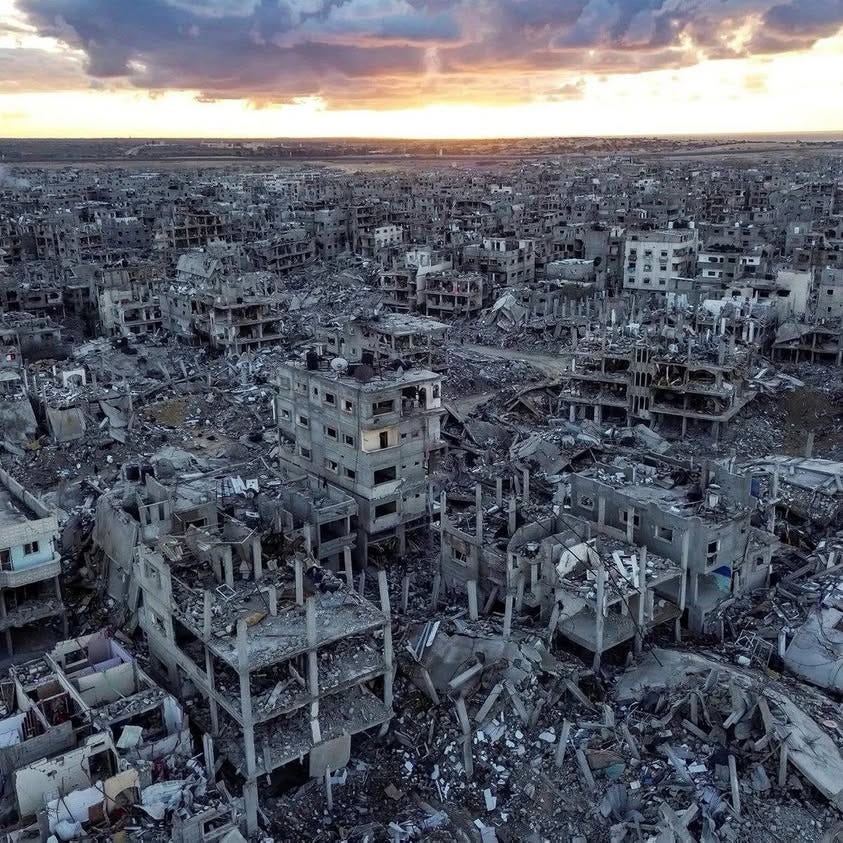
Now that the most inconclusive and ridiculous show in decades has concluded, with twenty or so world leaders flocking to Sharm el-Sheikh to act as extras in Trump’s show, but without the two real protagonists (Israel and the Palestinian Resistance), the question on the agenda is obviously what will happen after the spotlights are off.
Answering this question requires first understanding the reasons that led to the agreement. And first of all, it must be said that what’s in the so-called “20-point plan” counts for less than the paper it’s written on. And everyone is aware of this. The halt to the conflict—the truce, therefore, certainly not peace—is essentially due to the fact that Israel has proven incapable of achieving its political and military objectives, but has instead produced an unprecedented wave of international isolation, calling into question—perhaps for the first time in eighty years—the very existence of the Jewish state; A wave that was particularly felt in the United States, even affecting Trump’s electoral base—who already lacks widespread support in the country. Therefore, the truce responds to the US (and Israeli) need to avoid pursuing a path that has proven fruitless.
From the Resistance’s perspective, however, the decision to respond positively to the “plan” stems fundamentally from several strategic considerations. First, it was clear that the issue of Israeli prisoners had lost much of its effectiveness as a lever on the Tel Aviv government, but remained a political and logistical problem for the Resistance itself. Equally, the reasons pushing the US administration to want a halt were clear, as was the difficulty this would pose for Netanyahu. And, of course, the awareness that the truce would not only allow the Gaza population to catch their breath, but also to reaffirm the Resistance’s inescapable centrality.
At this point, therefore, beyond possible setbacks, it is reasonable to expect that the truce will hold. Not because Israel and the United States’ commitments are inherently reliable—far from it—but because it’s in their best interest, for the reasons mentioned above. Moreover, another aspect of Israel’s strategy is emerging in recent hours (which demonstrates, among other things, that they had been preparing for this event for some time): the idea was to use certain family clans in Gaza, long involved in criminal trafficking and sometimes linked to ISIS, as a sort of long arm of the IDF, which has, in fact, progressively aided and supported them over the past two years, providing both military cover and weapons and equipment. The presence of these gangs was intended to pose an obstacle to the Resistance’s control of the territory. However, the Resistance is well aware of its plan and is working to clear the Strip of these clans with swift and decisive military action. The most immediate issue, therefore, will be rebuilding a minimal administrative infrastructure capable of managing the resumption of food aid, rebuilding healthcare, providing assistance to orphans and the disabled, as well as the urgent issue of relocating the population for winter. This phase can only be managed by what remains of the old Hamas administration, with the support of resistance groups.
The next two issues—the timing and depth of the IDF withdrawal, and governance of the Strip—are preliminary to any reconstruction process and therefore represent the crucial issue. Israel will obviously seek to delay and limit the withdrawal as much as possible. But this depends on its ability (political, of course) to remove the Palestinian population from the areas it controls; in any case, it will tend, sooner or later, to withdraw into the planned “security zone” along the border—which is more symbolic than practical, and will require a military presence that is not sustainable in the long run. As for governance, it’s all too clear that, in the initial, rather lengthy phase, this will be assumed directly by the Resistance, for the simple reason that it’s impossible to impose an effective structure from above—and one that doesn’t exist, anyway.
The composition of this structure, therefore, will occupy a large part of the upcoming negotiations, which—once the media spotlight, and thus the leaders’ interest, has faded—will ultimately be entrusted to an army of Sherpa officials and will drag on for months, at best. This, of course, will allow the Resistance to reconsolidate its central role, including administratively.
Regarding reconstruction, it’s quite clear that it will require considerable investment, and therefore those who will have to put up the money—the Gulf countries first and foremost—will want to see a modicum of stability. Unfortunately, therefore, it’s not likely to begin soon. At least not on a massive scale, and not for the most costly issues (water and electricity systems, for example). However, it’s likely something similar will happen to what we’ve seen in Lebanon, where Hezbollah—which has relentlessly pressured the government to shoulder the burden of reconstruction—has launched its own reconstruction program, likely also using Iranian funds. Something similar could also happen in Gaza, where, if anything, the greatest obstacle could be the difficulty and time required to deliver the necessary construction materials and machinery.
The truce, therefore, has a good chance of lasting, at least in the medium term. But obviously, it’s not even remotely a peace, because it doesn’t even address the core issues underlying the conflict. The conflict will inevitably resurface. At the same time, it’s clear that this isn’t just a return to the previous status quo. Despite the optimism Trump spread liberally before, during, and after the two-part Super Bowl-style spectacle—Knesset and Sharm—these two years have indeed reshaped the Middle East, but not as Netanyahu believed. Today, the reality is that Israel is weaker, more internally divided, more isolated internationally, and more dependent than ever on the United States. The United States, in turn, is not doing so well. Iran, on the other hand, has established itself as a regional power, including a military one, perfectly capable of holding its own against Israel. And the Axis of Resistance, while obviously suffering significant blows, emerges undefeated from two years of war.
Everyone will begin preparing for the next round.