
THE DEFLATED BALLOON

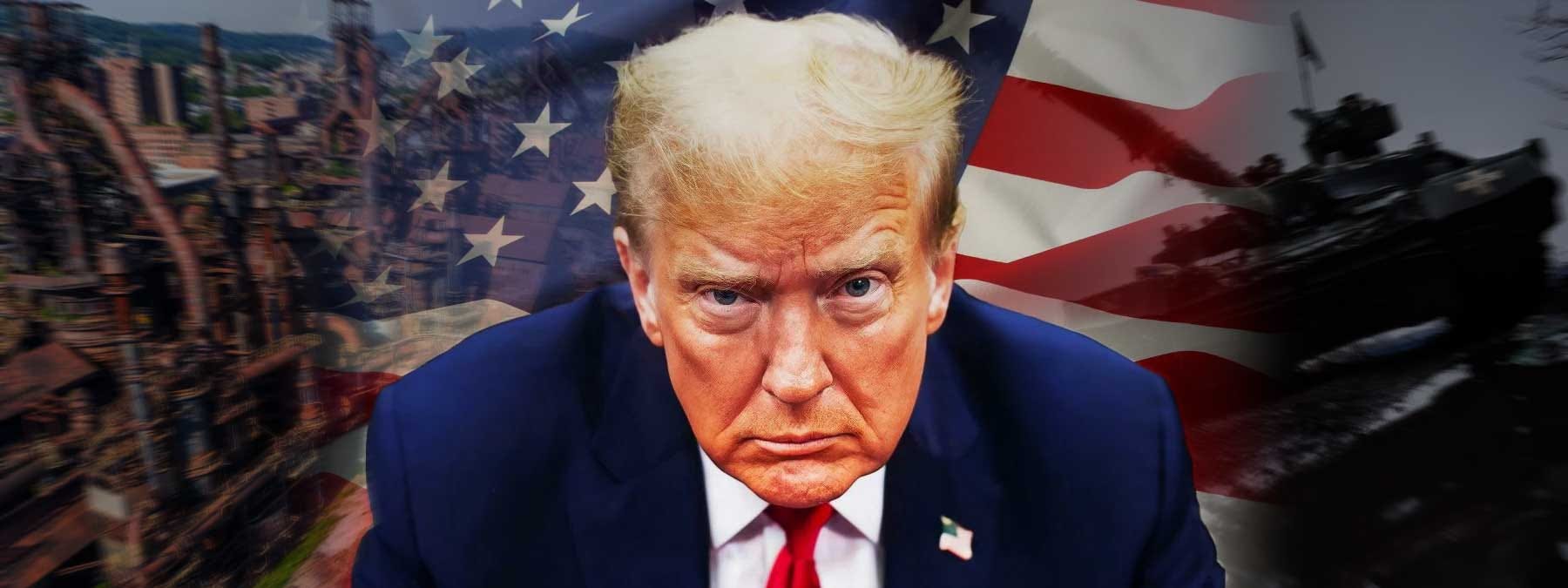
There is much discussion about the constant outbursts of the new president Trump, which are very often packaged precisely in order to ignite debate. And certainly, even net of the exuberant nature of the character, it is evident that - behind what too often appears as excessive language - there are in fact political plans and strategies, certainly not just the product of his imagination.
It is quite evident that the use of decidedly out of line expressions is in turn part of a strategic communication choice, which essentially materializes in a verbal posture imbued with a sense of superiority (if not outright contempt), which should convey the idea of an imperial power so strong (and so tired of having to compromise) that it has no qualms about brutally manifesting itself urbi et orbi. In short, Make America Great Again begins by showing an attitude - precisely - of a great power in existence.
At the same time, it is equally evident that the audience to which the message intrinsic to this not very subtle language is mainly addressed is essentially that within the United States; after having mobilized the electorate, which brought him to the White House, it is now necessary to maintain a climate of mobilization that supports the reformist action that Trump has in mind, and that he has begun to carry out. And to do this, massive doses of optimism and patriotism must be instilled among citizens.
Whether and to what extent this will prove effective and functional to the plans of the power group that expresses Trump, will be seen over time, also keeping in mind that internal resistance will be neither few nor of little importance.
But the most important question is whether this posture will prove equally effective and functional on the international level.
In the meantime, it is important to underline that authority and command are distinct things, indeed in some ways even antithetical. Authority is recognized, command must be imposed. If, then, one tries to impose one's will through threats, we are in another category, which is that - in the best of cases - of bullying.
Let us keep in mind that the authority of the United States, which in the past allowed it to make extensive use of soft power, is now largely eroded, even among friends and allies, precisely by virtue of the extensive use (if not abuse) that has been made of it. Just think of the sanctions mechanism, totally unilateral, which owes its (very partial) effectiveness precisely to the fact that it extends well beyond the subject it intends to hit. Because obviously it is one thing to tell a country that you do not intend to trade with it (neither sell nor buy), it is another thing to force third countries to do the same, under penalty of being subject to the same ostracism. This is clearly an approach that not only places US interests above those of anyone else (including friends and allies), but which claims to impose them even when they damage third parties. See the entry "ten-year sanctions against Russia".
When Trump threatens a trade war – with Canada or Europe – demanding a forced rebalancing of the balance of payments, on the one hand he further extends this domineering scheme, but at the same time he denies the foundation of American ideology (the free market), and for this very reason he raises a potentially ineffective threat.
Take for example the issue of trade between the United States and Europe. Trump's thesis is that this registers an imbalance in favor of the old continent (which exports in value more than it imports), and that therefore this must be corrected by increasing European purchases – especially of weapons and energy – otherwise 100% duties will be imposed on European goods.
But, obviously, the point is: why is there this inequality in trade between the two sides of the Atlantic? In a free market regime, this simply means that American products are less competitive (quality/price ratio) than others on the market, while European ones are more so. Always according to market logic, therefore, the most logical action should be to buy the equivalent of European products elsewhere. But – as is obvious – there is a huge ‘but’: it is clear that a) the USA needs these products, and b) buying them from other countries means paying more or having lower quality. So if the United States is not able (or does not benefit from) producing them themselves, they cannot help but submit to the laws of the market. Among other things, the blackmailing threat of duties, if it were applied, would translate either into a greater burden for American consumers (who would pay double for European products), or into a reduction in the import of those products (which would equally increase their cost to the consumer).
Obviously there are more complex political and economic considerations involved, so the choices will not simply be based on this scheme, but this remains the essence of the matter. And just as evidently, a possible war of tariffs (mutually imposed) would ultimately damage the country with the largest trade deficit, i.e. the largest importer, the USA.
An approach of this kind, therefore, even towards vassal countries such as Canada and Europe, can only generate countermeasures. Even more so if, as with European countries, they are already paying heavily for choices made to follow US interests. See again under the heading “ten-year sanctions against Russia”.
Equally critical, if not more so, appears Trump’s posture towards enemy countries. Observing the way in which, for months now, the new president has been approaching the issue of the Ukrainian conflict, some irrefutable elements are evident. The first, and most obvious, is confusion and disinformation (real and/or instrumental). This is evident first of all from the ease with which he continually changes the timeframe in which he presumes to resolve the problem; first 24 hours – obviously a joke, but repeated obsessively – then six months, then a hundred days but his envoy Kellog will see to it, and then he declares himself ready to meet Putin “immediately”… But all his speeches on the matter are also stuffed with pure nonsense (Russia has had 800 thousand deaths, more than the Ukrainians; the war is Biden’s fault – therefore the USA’s – but it is a European matter, because “there is an ocean in between”; it is Biden’s fault, but he removes the fact that he was the first to supply lethal weapons to Ukraine *; the Russians have hypersonic missiles – and the USA doesn’t – because they stole the project from America during Obama’s presidency…).
Furthermore, the real issues raised by the war are completely evaded, and an attempt is made to reduce everything to a limited dimension, geographically and politically. But, here too, it is the language used that appears totally inadequate, revealing the persistence of an absolute incomprehension (on the part of the United States) of the interests, the point of view, and even the mentality of the Russians. The essence of Trump's message, in fact, in addition to being extremely reductive, is summarized in the blandishments and threats simultaneously displayed. On the one hand, it is emphasized that it is also in Russia's interest to end the conflict, but on the other hand, further coercive measures are threatened if there is no expected willingness to negotiate - and by waiting, this essentially means in the terms envisaged by Washington. Saying that in that case the United States will give more weapons to Kiev and further tighten sanctions is clearly a coercive approach, which denies in nuce a fundamental aspect for the Russians, namely that the negotiations take place on an equal footing. It is in fact an approach based on the concept of “peace through strength”, which presupposes the supremacy of those who seek to impose it.
It is all too obvious, among other things, that these are blunt threats, given that Russia has been under sanctions since 2014 (annexation of Crimea), and that the US and NATO have been providing weapons, money and support of all kinds to Ukraine for ten years, and yet Russia is winning the conflict.
Then there is, fundamentally, the central question, which remains unresolved and unsolvable. While Moscow wants ironclad guarantees on the respect of any agreements, and above all tries to arrive at a sort of New Yalta, which redefines global balances in a stable and lasting way, Washington cannot and does not want to make long-term commitments, and even less sanction a reduction of its hegemony.
Seen in this way, it seems quite evident that there are no great possibilities of actually arriving at some agreement, even a partial one. After all, the real mission of the Trump presidency is to get the United States back on track, so that the next one (whether or not it is led by Vance) can tackle global challenges – especially the Chinese one.
On the international level, therefore, we can expect a substantial US disengagement, without however translating into absence, because obviously the void would be filled by others, and it would imply a loss of prestige.
Trump's gaze is turned towards the rough belt, rather than towards Donbass. And if you look closely, you can see it.
* as former NATO Secretary General Stoltenberg recalled yesterday in Davos, at the WEF.