
TURNING POINT

For a variety of reasons, widely discussed and shared by numerous analysts, many of them American, the chances of the conflict ending with an Israeli-American victory are, to say the least, extremely remote. The most likely scenario, therefore, is that sooner or later the United States will decide to disengage from this conflict as well, seeking a solution that somehow provides a foothold for the narrative of victory, even if in reality this will not be the case at all. The position assumed by the United States on the international stage is now completely indifferent to the opinions of vassal and enemy states, much less non-aligned ones. An unmistakable sign of this is the replacement of diplomacy with the exercise of deception and manipulation, not coincidentally outsourced to a pair of businessmen with no expertise or knowledge.
Victory is therefore essentially the narrative that must be sold to the American people to avoid crises of rejection, at least as long as some forms of democracy are maintained.
The question, therefore, is no longer how the war will end—who wins and who loses—but rather when, and what the implicit and explicit conditions will be that will accompany the end.
Obviously, if the above hypothesis is valid, this means that—in effect—it will not be an end, but a suspension. If the Americans opt out, regardless of what they invoke to do so, it follows that there will be no negotiations, and therefore no agreement. This will leave Washington free to resume the conflict, if and when it deems appropriate. And obviously, this is all the more true for Israel. From the Iranian perspective, the lack of a formal commitment not to resume aggression—an extremely tenuous one, given the US international positioning—can only translate into a determination to establish material conditions to prevent this from happening.
The United States will not pay war reparations, nor will it sign any kind of commitment. Consequently, the only factual guarantee Tehran can derive is the permanent unusability of US bases in the region—something that has already largely occurred.
Given the condition to which these bases have been reduced by missile attacks, and which will presumably become even more significant as the conflict continues, the question must instead be how the US will handle the issue upon disengagement.
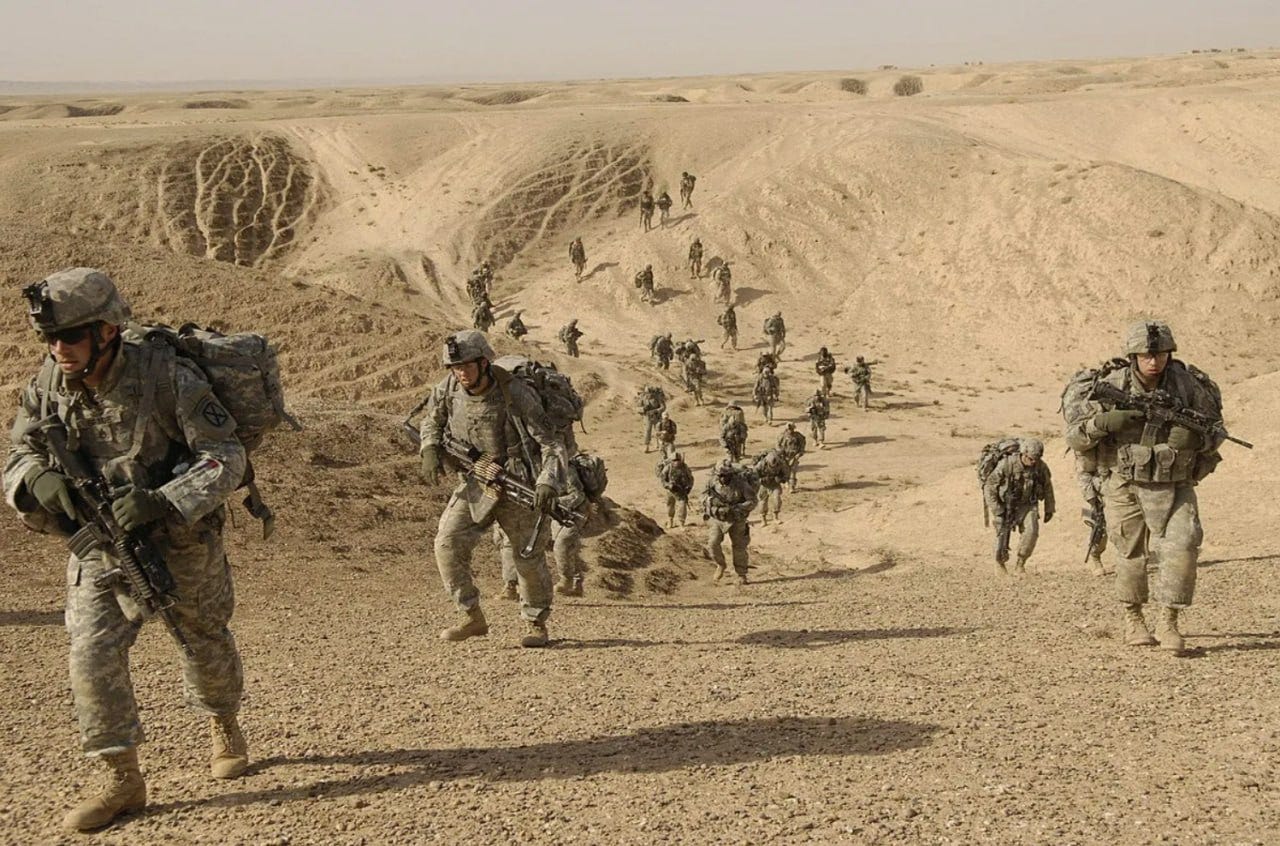
To maintain the narrative of victory, it is clear that attacks against US forces must simultaneously cease, and there is only one way to do this: withdraw them. Currently, the bulk of US troops are stationed outside the Gulf region, mostly in Jordan and Iraqi Kurdistan. Those still in the Gulf are mostly housed in hotels and private facilities, while only a small portion of essential personnel remain at the bases. Therefore, the simplest course of action for Washington would be to redeploy forces away from the bases, concentrating them in Jordan and (perhaps) Israel, leaving a few small garrisons in the Gulf countries but within non-military facilities. Obviously, much depends on the conditions under which the kinetic war ends, as these will immediately impact both relations between Iran and the Gulf Arab monarchies and between them and the United States. Clearly, Tehran will exert strong pressure to expel US forces from Arab countries, but the position of the latter after the US withdrawal will be decisive—which would mean leaving them even more exposed to Iran.
But it should not be underestimated, more broadly, how such an outcome will affect relations between Washington and Tel Aviv.
At that point, in fact, it will be entirely clear what many commentators are already saying: that what pushed the United States into this conflict—or at least, what pushed it into it now, and with those objectives—was the false information received from Israel. This would therefore emerge as a significant contributory factor to the strategic disaster. In a context where America is forced to reduce its military presence in the region, and recognizes the substantial ineffectiveness of its aircraft carrier-based power projection model, Israel’s responsibilities in this debacle must be properly assessed.§
Conversely, a substantial US withdrawal from the Middle East, which not only leaves the Jewish state holding the hot seat of war but also represents a significant weakening of the protection provided by those forces, will in turn have an impact on Israel, and therefore require a rethinking of its relationship with the main sponsor and guarantor of its survival. Clearly, in such a context, the New Sparta project Netanyahu’s vision would be completely impractical; complete defensive autonomy—already essentially utopian in itself—would be definitively dismissed as impractical, and Tel Aviv’s greatest concern would suddenly become how to ensure its survival in a suddenly changed regional context, where the balance of power has been completely reversed.
Not to mention what could happen within the Israeli state, which, after the resounding failure of October 7th, for which society still awaits answers and accountability, would find itself faced with a new, resounding mistake that calls into question Israel’s security.Trump’s statement that the conflict will end within two to four weeks must be interpreted in light of a complex set of factors, from the looming global crisis—as a result of this foolish move made in collusion with Tel Aviv—to the growing ammunition shortages, from the internal backlash ahead of the midterm elections to the concrete possibility of closing Bab el-Mandeeb—following the entry of Yemen’s Ansarullah into the war—and, last but not least, the approaching deadline imposed by the War Powers Resolution. Within 60 days of the start of operations, i.e., the end of April, authorization from Congress (which would have to declare war on Iran) will be required, otherwise there are another 30 days to withdraw the forces involved in the fighting. As I’ve said on another occasion, that too could be an exit strategy, placing the blame on Congressmen, but it would be somewhat humiliating in any case, so he’ll do everything he can to find another way to get out without paying the price. The outcome of this war will determine not only a realignment of the balance of power throughout the Middle East, but also within the US power system. The current rift within the MAGA movement, one of the factors threatening the Trump administration’s electoral stability and consensus, could either heal (in light of the de facto disengagement from Israel) or worsen, leading to an internal showdown.
However you look at it, this war is a turning point.